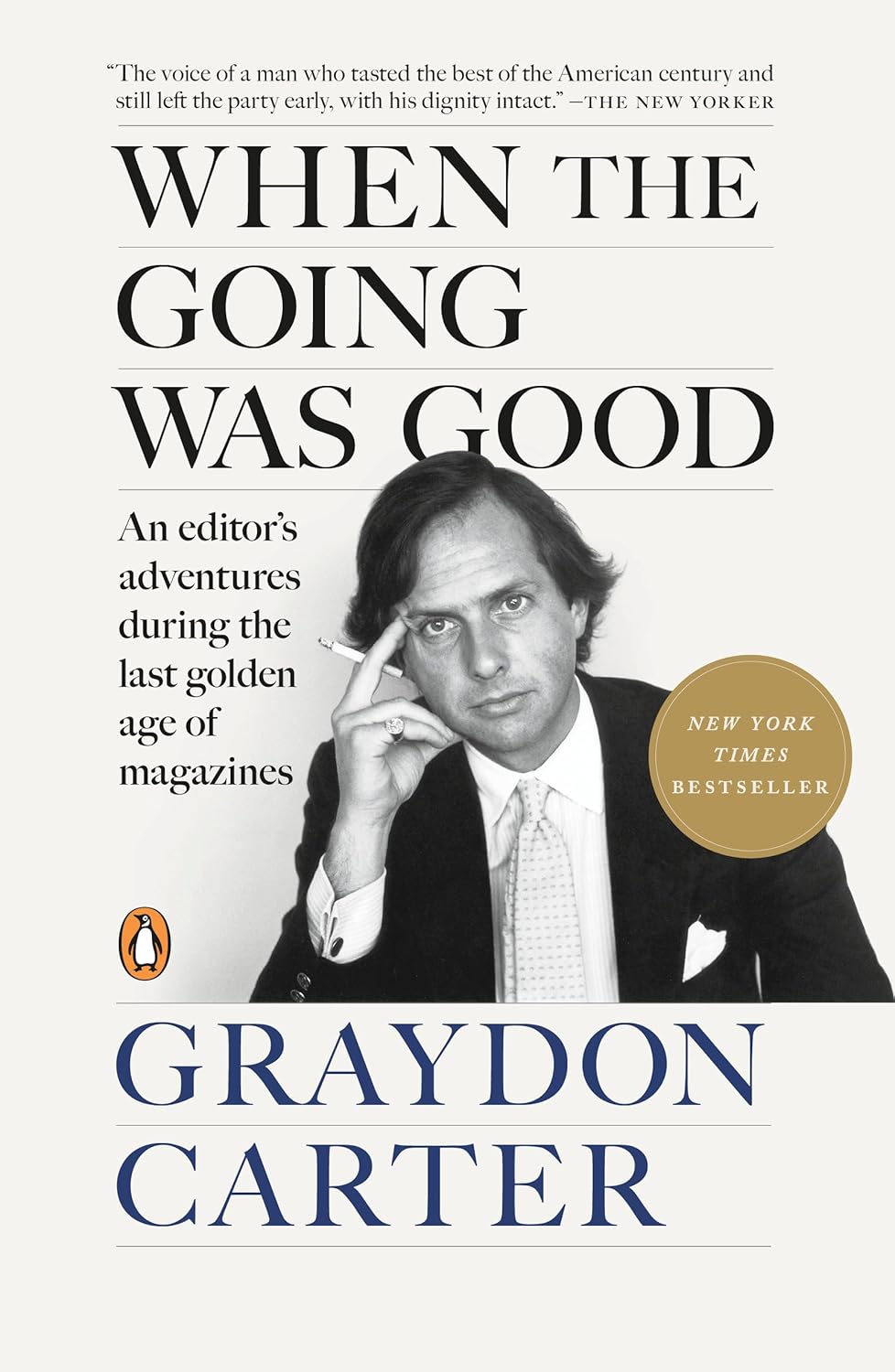
When the Going Was Good by Graydon Carter
If you too remember the golden years of magazine publishing, you will love Graydon Carter’s memoir, When the Going Was Good. But even if you are a lifelong digital native, the classic story of a boy from “away” who makes good will resonate.
Born and raised in Canada, Carter dreamed of living in New York City (specifically Greenwich Village). Also, on his wish list:
- Becoming the editor of a big, general interest magazine (Time, Life, The New York Observer, Spy, Vanity Fair)
- Being one half of a wonderful marriage (A goal he achieved three time)
- Having a large, happy family and a dog. (See number of marriages)
Carter started in publishing at The Canadian Review, a literary and poetry magazine that he co-founded in college. Despite having a decent circulation of fifty thousand, the magazine folded after four years leaving Carter without a job or a college degree. (Editing a magazine and attending classes were incompatible!)
At a girlfriend’s suggestion, he applied and was accepted to the Sarah Lawrence College five-week publishing program. At its conclusion, he cold-called all the guest speakers for job interviews. Despite his slim resume, Time magazine hired him. It was 1978.
After jobs at Time, Life, and The New York Observer, Carter co-founded Spy, a smart, satirical monthly about New York. I loved Spy, not the least for coining the epithet “short-fingered vulgarian” for Trump, a nickname he is still sensitive about forty years later.
Despite his somewhat puckish appearance, Carter was a furiously hard worker and nowhere was this more evident than in his illustrious position at Conde Nast’s Vanity Fair.
Carter was originally offered the top job at The New Yorker, also a Conde Nast publication. However, two weeks before his start date, Tina Brown was given that job, and he was shuffled over her former position at Vanity Fair.
No one was happy about the switcheroo, except Tina Brown. At Spy, Carter spent years ridiculing the members of the Vanity Fair community, celebrities, socialites, authors, New York power brokers, Hollywood studios, advertisers, and even VF staff and contributors. All were horrified by his promotion. Tina Brown’s holdover staff was openly hostile as well. Carter says, “The first two years at Vanity Fair were pretty dreadful.”
To remake the magazine in his “voice,” Carter edited every word that went into the magazine (for twenty-five years) and with Si Newhouse’s generous budget, he hired the best writers, editors, and photographers.
In a moment of pure genius, although it wasn’t obvious at the time, he rebranded the late Swifty Lazar’s Oscar Party which became the place to see and be seen. The turnaround was complete.
Carter stepped down from VF in December 2017 and spends most of time in the South of France with his third wife.
An excellent read-humorous, anecdotal (but not gossipy), with shrewd cameos of the celebrated and the crass.